
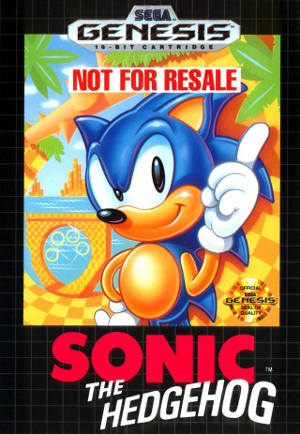
By 1990, Sega was enjoying newfound success with their new 16-bit Genesis system. It quickly became a competent competitor to the NES with popular titles like Golden Axe, Phantasy Star II, and Revenge of Shinobi. But despite the rising success of the Genesis, the platform didn’t have a brand character that could rival Super Mario. Tasked with creating such a mascot, character designer Naoto Oshima came up with Sonic- a blue anthropomorphic hedgehog. Sonic the Hedgehog was released on June 23, 1991- two full months ahead of the Super Nintendo’s debut in America. It was a big summer for Sega, and today marks the 30th anniversary of the moment that made them an icon in the home console gaming space.
This was the game that made me sit up and pay attention to the Sega Genesis. I still remember that fateful summer afternoon watching TV with my brother and sister when I saw the commercial that forever changed my life. Watching Sonic effortlessly run through the loop, transition into a rolling ball, and blow a raspberry at the nagging old lady made quite an impression on me. I officially needed a Genesis. A brave new world was underway, and I wanted in.
Our story begins with Dr. Ivo Robotnik- a mustachioed rotund mad scientist capturing animals and turning them into robot slaves for world domination or something. Enter Sonic- the hedgehog with a spiked haircut, power sneakers, and 90s ‘tude. He has made it his mission to free his friends from brutal captivity and thwart the vile plans of Dr. Robotnik. But little did our blue friend know that this was the beginning of a long, long relationship.
The most prominent element that made Sonic the Hedgehog unique was its focus on speed, albeit more implied than demonstrable. The zones often have springs, slopes, loops, and steep hills that further assist Sonic in reaching higher places and greater speeds. In contrast to the friendly, happy-go-lucky persona of Mario, he exhibits more of a bold exterior. If he stands still for more than a few seconds, he’ll impatiently start tapping his foot, beckoning the player to keep it moving. After all, he’s got things to do and places to go. That personality detail worked well by giving Sonic a distinct personality instead of being a mere rip-off of a popular character.
The gameplay is based on momentum physics, which meant that Sonic’s speed and forward energy could often be used to his advantage. For instance, if he’s going down a steep hill while using his spin-attack, his velocity increases and can quickly destroy any vulnerable enemies in his path. And despite Sonic’s ability to blaze through different areas, the controls were spot-on. He responds well when you need to change directions or quickly jump over a chasm and other hazards.
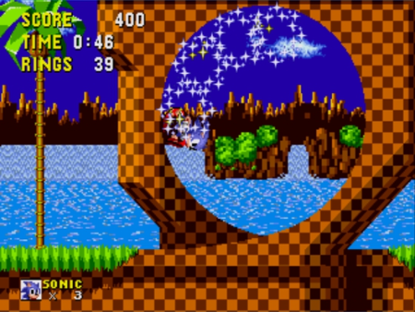
Throughout each zone, you collect golden rings that protect him from losing a life as long he has at least one ring in his possession. I remember playing this for the first time and being pleasantly surprised to discover that Sonic could recover some of his rings after taking damage rather than it being a total loss by default. Strewn about each zone are monitors that contain useful items. Some have extra rings, speed shoes (which allow him to run twice as fast), a shield, Invincibility, or a 1-Up.
There are a total of six zones divided into three sections the game calls “acts.” Every third act ends with a battle with Dr. Robotnik. He’s always using a new machine to try and defeat you. I always found him to be one of the more interesting antagonists in video games because it reminds me of the antics of Wile E. Coyote vs. Road Runner- always using some sort of gimmick to subdue his speedy prey. I always found it humorous that, once defeated, Dr. Robotnik briefly turns beet red and hurries away, having suffered defeat.
The game’s biggest downside is that nearly all of the environments are designed such that you’re constantly stopping or taking calculated jumps, lest you fall to your death or some other detriment. It’s unfortunate because the central idea of Sonic as a character is that he’s supposed to be fast and zip around everywhere. But in practice, this first outing doesn’t deliver as fully as one might expect. That flaw might turn off newcomers or previous fans who grew accustomed to later sequels where levels are better designed to show off his speed and agility.
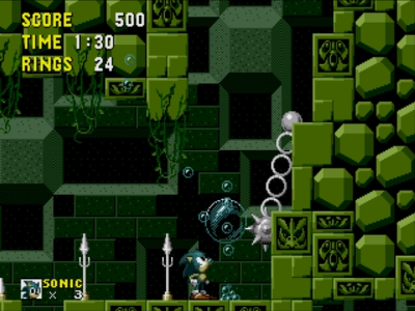
Underwater sections like the Labyrinth Zone are particularly challenging since Sonic moves slower in water. And this brings us to what would become another defining trait. Unlike Mario, Sonic cannot hold his breath indefinitely. Once you dive into any aquatic area, you’ve got 30 seconds to find an oxygen bubble, or he’ll be sleeping with the fishes.
No game before this one ever gave me the fear of drowning my character as this did, thanks to the scare chord that plays when he only has 5 seconds left before he bites it. I guess I assumed that all video game mascots could hold their breath indefinitely. Well, with Sonic, I learned the cold truth. To this day, the final stretch in the third act of Scrap Brain Zone tends to give me heart palpitations.
In addition to freeing his friends and battling Robotnik himself, Sonic can also attempt to collect the six Chaos Emeralds in the game’s bonus stages. You access it by finishing the first or second act with at least 50 rings, allowing Sonic to jump into a giant ring at the end of the stage. Each bonus stage is a rotating maze that Sonic must navigate.
Some sections of walls are littered with pinball bumpers that bounce you all over the place. There are also buttons that either increase or decrease the speed of the maze's rotation. You obtain the precious Chaos Emeralds by breaking through a jeweled barrier surrounding it. You also must avoid the “goal” walls that force an early exit from the bonus round. It’s a deceptively simple requirement that can be pretty challenging with each attempt.
Remember the original line of Genesis consoles that had the “High Definition Graphics” logo on them? Well, this game certainly did that label justice. The game had more colors than in older Genesis titles and ran silky smooth without any major hiccups. The game simply looked gorgeous. Based on the title screen alone, you could tell that you were in for a good time. Each zone’s background was well-detailed with scenic overlooks, ancient ruins, urban buildings, and smog-spewing industrial factories. The attention to detail packed into the game was impressive.
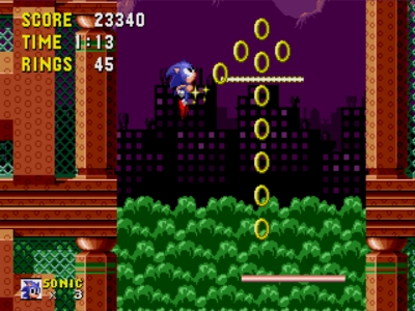
The music was another major factor in Sonic the Hedgehog being well received. The entire soundtrack was composed by Masato Nakamura—a member of the J-Pop band Dreams Come True. The score was a cut above anything that came before it and felt contemporary for its time. Of particular note is the music for Spring Yard Zone, in which Nakamura drew inspiration from the New Jack Swing stylings of Bobby Brown’s “Every Little Step.”
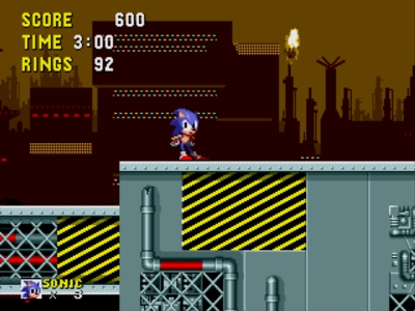
Another favorite of mine is Scrap Brain Zone, not only because of its nod to Blade Runner (the level itself being a visual reference to the movie) but also because it is the only song that fully loops back to its opening chords. Interestingly, you get treated to a mini-mix of each level’s music during the end credits—my first recollection of hearing such a thing in a video game. The audio works in this game showed off the technical prowess of the Genesis hardware in the right hands. It was actually worth using the headphone jack in the original model to hear the crystal clear bassline and drum beats.
Sonic the Hedgehog was a fresh take on the platformer genre and a boon for Sega. The Genesis console skyrocketed in popularity and relevance. It motivated Nintendo to coax the Super NES out of hiding and kicked off a console war the likes of which we haven’t seen since then. Sega understood that if they wanted to have a fair shot at beating Mario, they couldn’t have a mascot trying to be Mario. Finding this game is very easy these days. In addition to the original cartridge, you can get it as part of the Sega Genesis Classics compilation available on most current gaming platforms as of the date of this review. If you love 16-bit platformers, Sonic the Hedgehog is undoubtedly worth a look.

The Spring Yard Zone theme was my favorite track from the game.
I think that in some ways I enjoyed Sonic's first couple of outings every bit as much as SMW. One of my gripes with the series was the fact that there was so much emphasis on running and speed - blast processing, baby - yet the level design hindered that speed because you'd run smack into lethal obstacles before you could react, and a lot of levels simply weren't conducive to running. When it came to areas requiring tight platformong, that's where Sonic's weaknesses compared to Mario would really show. Sonic was simply nowhere near as responsive as a Mario game, and one of the things I love about SMB3 is that the controls are near-perfect. And that was an 8-bit game, not a 16-bit game. Sonic never really achieved that.
Personally, I've never had issues with the controls on the 16-bit Sonic games. But I agree that this first game was not built for speed. the sequels kinda struggled with it in parts as well. I think that's a big reason why Sonic is downright hated by certain folks. The whole speed thing was more branding hype than factual.
"Hate" seems like an extreme reaction. While it sucks that Sonic's famous speed is a liability in many parts of his games, they're still great games, for the most part.
I also remember catching a few episodes of the DiC Sonic cartoon where the hedgehog was voiced by Jaleel White, who was best known as Steve Urkel. He sounded more like Stefan Urquelle in the cartoon.
Yes! I remember the commercials for the cartoon back then. My brother pointed out that Jaleel White did the voice. I was floored at the notion that an actor can play more roles than just the one he's known for.
SYZ is my favorite, in the entire series, and still one of my favorite and most memorable game tracks. Starlight and Scrap Brain are so good too.
I know I'm going to get tomatoes thrown at me, but I didn't really like the first Sonic game. Sure it looked really cool on TV, but once I played it at a demo station (remember those), I asked myself, "This is better than Super Mario World...HOW???" Like you said, for a game all about speed, they sure do penalize you when you go fast. For me, Sonic didn't get good, or at least halfway decent, until 3. Sonic 2 made me take notice because I thought Tails was cool. Tails and Ulala are my favorite SEGA characters.
Don't worry Cary- This is a tomato-free zone. You're safe here!
I didn't play the OG Sonic until I was in my early 20s, but I love all of these games. For me, Mario is more about precision platforming, whereas Sonic is all about speed. Sonic is a bit too slippery for precision platforming, but it sure is fun to run super fast. Each game got better too, culminating with Sonic 3 and Knuckles being fantastic games.
Yeah, I love that each mainline Sonic game on the Genesis kept getting progressively better. I have very fond memories of playing Sonic 3 and Knuckles countless times.
I love this game, but I've never beaten it. Those darn chaos emeralds, man....
Really? You've never beat this game? That's cool. At least you'll always have something to look forward to finishing.
This was my shit back in the Genesis days. One of those games that gets etched on your subconscious.While 2 and 3 play better, they never quite hooked me like the first.
I thought the thing about Scrap Yard Zone theme being based on Every Little Step was a apocryphal.
But this goes to show why I thought the music in Sonic 2 was a step down. They just sounded like video game music, with a harsh digital tone (imo), while the songs in Sonic 1 sound like "actual" songs. Warmer, familiar. This sound would make a return in Sonic 3, although to a lesser degree to my ears.
And the graphics have held up very well. Can't say they look worse to me now than when the game came out.