
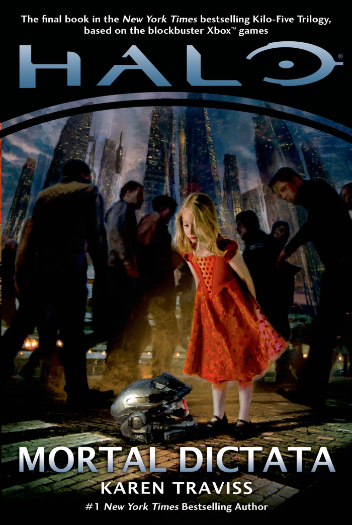
Halo games have continuously fumbled the stories that justify Master Chief and crew blowing everything up. Somehow amongst this mess of in-game cut scenes, a colorful and interesting sci-fi universe with tons of potential was cobbled together, ready to be harnessed by a real pro. Karen Traviss has worked wonders with Halo’s raw materials in the final installment of the Kilo-Five trilogy, Halo: Mortal Dictata, giving us an action-packed book with moral quandaries and personal relationships injected throughout – intensely better than the clunky narratives the games foist on us.
The entire Kilo-Five trilogy has focused on smaller conflicts than you might expect if you’re only familiar with the games or the other Halo novels. This isn't to say there's not mayhem and destruction, but the quieter nature of the trilogy is most notable in Mortal Dictata. The story revolves around infiltrating an outer colony of humans and Kig-Yar (the birdlike aliens) to stop an insurgent from getting his hands on an old Covenant vessel that has the capability to glass part of Earth. It’s the perfect set up filled with opportunities to push our empathy buttons for several characters as they try to sort out their pasts, each brutally impacted by the nature of a futuristic military and its conflicts with aliens and rebellious humans.
There is the truly sad retelling of a father looking for his child who was abducted to become a Spartan-II. We see the struggles of high ranking naval intelligence (ONI) personnel as they grapple with continuous moral quandaries in order to keep as many humans alive as possible, even if the means to get there are a little messy. Even the emotional journey of self-discovery for the artificial intelligence, BB, is pretty endearing. The morality of cloning, the underhanded dealings of wars, and the humanity of artificial intelligence aren't new themes to sci-fi writing, but Traviss deftly handles them all and has the benefit of dashing in some real Spartan ass-kicking to keep things juicy and not too high brow.
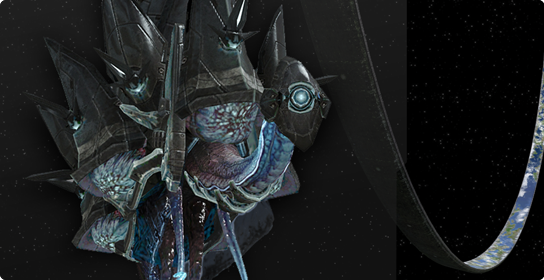
The thoughtful moments never turn into a plodding mess or into lengthy lectures on tariffs and interstellar politics – they give us just the right amount of details to get the background and understand how the characters are experiencing their world, filled with unsettling Forerunner artifacts, drifting tentacled aliens, and slipspace jumps. It’s a wonderful use of the backdrop created to host endless rounds of shooting aliens, and one we can only hope the game developers take some cues from. The game stories don’t appear to be improving what with the hokey budding romance between Master Chief and Cortana on the other side of the universe in Halo 4, but there are glimmers of hope in a few of the cutscenes.
I’m certain the games will never achieve (or even try to achieve) the sort of personal connections given to us in Halo: Mortal Dictata, but at least we have a way to get some deeper insight into the world that rides on the back of Master Chief. There’s certainly no reason why a fan of the Halo games should feel obligated to tackle the Kilo-Five books, but if you've had a moment where the fictitious universe looked like it could open up and offer more than what you’re seeing through John-117’s visor, Traviss' novels are probably the best place to start. Halo: Mortal Dictata is a powerful conclusion to a thrilling and humanized series that gives Halo fans the action they love and the characters they deserve.

Hmm, interesting piece. I actually have the original Halo novel written years ago, but have yet to read it. Should I still read that (and others in the series) first, or can I hop right into this one if I choose?
Not sure what you mean by "original." If you mean The Flood, I would skip that one.
You can jump right in to the Kilo-Five books with only a basic knowledge of Halo stuff from the games. The authors of all the books do a good job of getting you up to speed.
Similar question: I'm completely unfamiliar with the Halo universe storyline. Where should I start and go as far as reading material?
I wonder if KnightDriver has seen this review, he was reading this book.
I'd probably start with The Fall of Reach. You know parts of this story already, but it gives you more background and other angles to the conflict at Reach and the general human/Covenant war. Also, it's a book by Nylund, who handles this material well.
"You know parts of this story already" Actually when I say unfamiliar with Halo universe, I mean including the games, none of which I ever played for more than a few minutes on single-player, so I know nothing. Nothing!! But thank you, I'll keep that in mind. lol
Hahaha... Why you're interested at all is a mystery to me, then, but you should still start with The Fall of Reach. I'd be curious if someone without any knowledge of the games would find the books interesting. Try and let us know!)
(I can't delete that smilie on my phone. Enjoy!)
I meant the very first book written among the Halo novels, but after looking at that cover art, I'm not sure "The Flood" is the one I own after all. But I have to ask--why do you think that particular book is skippable? Is it poorly written or simply not important enough in context of the other titles? Anyway, thanks.
It's just a retelling of Halo: Combat Evolved. Which, as you can imagine, would be difficult to turn into an engaging book. It's a lot of pure descriptions of shootouts and movements through buildings and caves. No slight against the author, because that would be a very difficult thing to write, but it's not a great book. The Fall of Reach is definitely the best place to start. Great tales of space battles like you never get in the games and a real feel for how outmatched humans were in the war with the Covenant. The space battle make me really desperately want a space combat game in the Halo universe. Let me command a slow-moving battle cruiser and I'll be thrilled!