
I started with just arcades but then got carried away with other interesting releases and facts of the later half of the 70s. This is the time I became more interested in games.
Recently, I livestreamed an (almost) complete playthrough of Richard "Lord British" Garriott's 1982 RPG, Ultima II: The Revenge of the Enchantress. These videos were originally simulcast on my Twitch and YouTube channels.
Note: This is my second attempt to post this blog. My first attempt, the site ate everything after the introduction to Xanadu.
An anthropomorphic animal high school where young furries have to perform trials, not unlike those in Hunger Games, or face starvation. I found the story and relationships gripping, but the targeting controls were terrible. I had to play a pin-the-tail-on-the-furry minigame that was near impossible. That tail looked funny on a nose though. I went and played the following four games and watched a tv episode instead.
One of my first RPGs was Ultima III: Exodus on NES and PC. Ultima, along with Wizardry, was considered to be one of the two ancestors of the video RPG genre. Eventually I was able to get a hold of the other games in the series. The entire series is on GOG, including the spinoffs like Worlds of Adventure and Underworld.
I didn't have a NES growing up, but my best friend at the time did, so I spent almost every afternoon at his house playing his NES with him until it was time for me to go home to dinner. I'm pretty sure his parents got tired of me hanging around so much.
Every month, another year forward in my life. I started 2017 with my birth year of 1967, and now I'm about to enter the 80s in 2018. I'm using this method to choose all types of media, but I'll focus on the games here.
I'm talking the years 1977-1979. These were my pre-teen years and the beginning of my education in everything nerdy. I saw Star Wars; I played Advanced Dungeons & Dragons; I watched Star Blazers (or Battlestar Gallactica, if you're not into anime); I read The Silmarillion; I went to arcades and played Space Invaders and Asteroids; and I played handheld systems by Mattel Electronics - Baseball being the one I owned. But most importantly was the Atari VCS (later the 2600) I got for Christmas, the first really succesful home video game console.
WARNING! Serious weirdness follows. What do you expect from the dream world?
Continuing my obsession with Dragon Magazine. These are my notes to the articles within.
1979 still saw the Atari 2600 unchallenged but Mattel was test marketing the Intellivision which was soon to give it a run for its money. I played Adventure and Superman that year on the 2600. The arcades saw the releases of Asteroids, Galaxian and Lunar Lander, three pieces of an only partially complete killer arcade along with Space Invaders. On PC Richard Garriott made role-playing game Akalabeth, but you probably had to be in California to know of it (I believe there is a version for phones right now I'd like to try). And Star Trek: The Motion Picture was released in a year full of great films, however, this is the only one I can reliably remember having seen in the theater. The rest I would see via VHS rentals soon after.
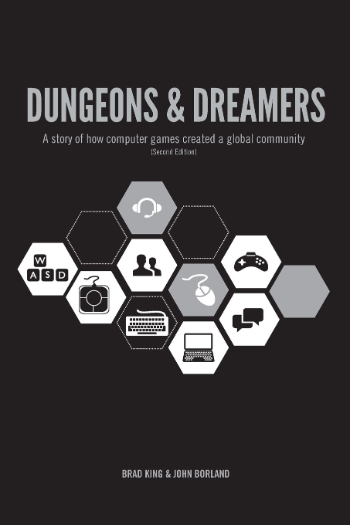
We throw around the word “community” in the video games arena without a second thought. Even small enthusiast sites have community managers and a myriad of other ways to strengthen and connect people who are passionate about games. If it weren’t for several key creatives that helped form the gaming landscape through the decades, though, we might not have the communities we all take for granted. Dungeons & Dreamers’ updated second edition guides us on a journey that shows how communities became so important to gaming. It’s an intriguing thesis that is hammered home with a continuous chain of examples that make it undeniable how integral community has always been to video games.
This week I picked up a bunch of Doctor Fate comics on the cheap after a friend said Doctor Fate was like DC's version of Marvel's Doctor Strange - a favorite comic character of mine. I found out later that Doctor Fate preceeded Doctor Strange by about twenty years (DF started in the 40's and DS in the 60's). Anyway, I noticed DC tends to not have as many ads in their comics as Marvel, most of them being ads for other DC comics - like the way indie comics do. But they do have video game ads here and there and I got six of them out of issues 32 to 41 of Doctor Fate all released from Sept 1991 to June 1992.